Showing posts with label article. Show all posts

Thursday, August 1, 2013

Alums, preservationists fear Casper deaf-school demolition
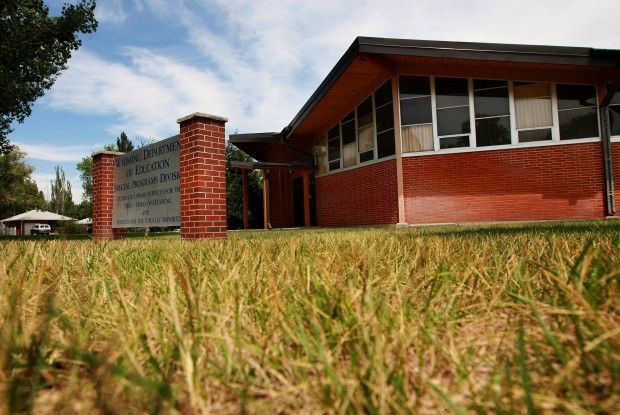

Alums, preservationists fear Casper deaf-school demolition


By KELLY BYER


The former Wyoming School for the Deaf is more than just an old building to some.
To Dan Frazier, who attended the school in the ’80s, it was a life-changing experience, he wrote in an email.
Julianne Orth, an alumna from the 1970s and ’80s, described learning sign language and playing sports on the playground at the school, which is attached to Pineview Elementary School on Payne Avenue.
“Wyoming School for the Deaf is very popular in the world,” she wrote in a letter.
They, other alumni and the Casper Historic Preservation Commission believe its future is in jeopardy, though, and are attempting to garner enough support to save it.
Hillary Lindmire, a member of the Casper Historic Preservation Commission, said state and local school officials assured the commission last winter that the school would not be torn down. But by spring, the group was told plans could include demolition.
Built in 1961 and opened to students in 1963, the school was designed by the local father-and-son architect team of Krusmark and Krusmark. Lindmire said the younger Krusmark had two children who were deaf who inspired his work.
Barbara Dobos, a member of the historic commission, said they designed it with the hearing-impaired in mind – the gym floor and rotunda helping to transit sound, for example.
The school closed in 2005 when students were mainstreamed into their local school districts.
Dennis Bay, the Natrona County School District’s executive director for business services, said the school district has an agreement with the state to provide maintenance for the building while the Wyoming Department of Education operates a library and resource center in the rotunda.
Pineview Elementary School is in the preliminary stages of reconstruction, which could separate it from the former school for the deaf.
“If we build a new building there, separate from the school for the deaf, the state then would take over all the maintenance and custodial duty for that building,” Bay said.
He said early conversations with the state Building Commission indicated the state did not have the money to continue caring for the former school and would prefer demolition. Bay said there is a possibility the new elementary school would include services for the deaf. The project is currently in the design phase, and the state has not yet allocated construction money.
Anthony Hughes, spokesman for the state School Facilities Department, said construction money won’t be in next year’s budget, which will be approved during the 2014 Wyoming Legislature’s budget session. The state, he said, has made no decisions about the future of the deaf school because plans are “premature.”
“There are really no construction funds available yet,” he said, “so there’s a number of options on the table.”
If demolition is an option the state pursues, Hughes said there will be a public hearing before the former Wyoming School for the Deaf is torn down.
Lindmire said a hearing is “good news” but doesn’t represent enough public involvement. She’d like a discussion about the possibility of incorporating the building into a new elementary school.
“One of our big concerns is just that the community hasn’t had a chance to actually weigh in on this,” she said. “It is a historic building, and it’s very important to the deaf and hearing-impaired community, as well as Casper.”
When the building was slated for destruction in 2007, the deaf community and supporters submitted about 7,000 signatures to the Wyoming Department of Education to prevent its demise. Lindmire said the state still intended to tear it down, but lacked the demolition funding.
The historic commission is interested in maintaining the building because it is an example of modern, mid-century architecture. Lindmire said it has a “butterfly roof” that peaks and slopes and a unique rotunda, where the library and resource center are currently located.
Lindmire lives in the area, which includes post-war World War II houses, and said the building acts as almost a centerpiece.
“It goes beyond just the school building, but also to the whole neighborhood,” Lindmire said.
It’s also indicative of historic education trends throughout the state. Lindmire said the connection to Pineview Elementary School was seen as a precursor to “mainstreaming” because students could attend classes at the elementary school while having access to special services.
Laura Ratcliff, who taught at the school for 14 years, said educators would pre-teach and review coursework that hearing-impaired students learned at Pineview.
“It was the first state school that really mainstreamed into the regular elementary schools,” she said. “It was a real new concept then.”
The school also served as a kind of second home to students, where they could communicate with teachers and peers. Ratcliff, who now teaches hearing-impaired preschoolers, said she still refers families to the resource center for books about deafness and sign language.
“It keeps us all connected,” she said. “Even though that we’re all separate right now.”

Source: Casper Star Tribune

Thursday, July 25, 2013

Agency, Alumni Frustrated by Plans to Tear Down Wyoming School for the Deaf

Agency, Alumni Frustrated by Plans to Tear Down Wyoming School for the Deaf

The future of a building that housed the Wyoming School for the Deaf in Casper for more than 40 years is once again uncertain.
The former school, which is attached to Pineview Elementary School, staved off demolition in 2007, when supporters of keeping the historic structure standing gathered more than 7,000 signatures on a petition they submitted to the State Department of Education. The agency still planned to tear down the School for the Deaf, but lack of funds prevented the proposed demolition.
Now, state education officials would again like to see the building torn down, according to Dennis Bay, director of Business Services for the Natrona County School District. Bay said the Department of Education wants the building off of its inventory, primarily because of its maintenance costs.
Although the school closed in 2005, it still serves as a library and resource center for deaf and hearing-impaired students and staff specialists. Services for visually impaired children and adults are also provided at the building, which hosts educational workshops and  reunions of former  Wyoming School for the Deaf students.
If aspects like the wood and hollow floor are so important and worth recreating, why not look at ways to incorporate the original rotunda into the new design?
The Casper Historic Preservation Commission and alumni of the school are both fighting the proposed demolition, which would take place in 2014 under plans to build a replacement for Pineview Elementary. Bay said funding for the construction still has to be approved by the Legislature, which is scheduled to consider the issue at next year’s session. Until money is available for the project — which includes the school’s demolition — it will remain standing.
State education officials have proposed dedicating between 2,000 and 3,000 square feet of space in a new Pineview School to house a new library as well as offices for Outreach Services for the Deaf and Hard-of-Hearing research and media specialists. Some aspects of the original school’s design would be recreated in the new space.
“The commission as a whole is disheartened by the impending loss of the Wyoming School for the Deaf building. … [which] is noteworthy for a variety of reasons, including the important role it played in educating Wyoming’s deaf students as well as its unique, purpose-built architecture,” noted Connie Bryan, chairwoman of the Casper Historic Preservation Commission, in a letter to the local school district.
While Bryan said that memorializing some of those special qualities in the new structure is an interesting idea, “If aspects like the wood and hollow floor are so important and worth recreating, why not look at ways to incorporate the original rotunda into the new design?”
In 2007, when the fate of the building was being decided by the state, Kathleen Holmes, one of the WSD’s first students, said, “It’s indeed sad that all the memories and the historical site of the Wyoming School for the Deaf will be wiped out when it’s torn down.”
Once again, alumni of the school are stepping forward to protest the proposal to tear down the former school as part of the new Pineview construction. Meghan Watt attended the school from 1991-98, after her parents moved to Casper solely so she could be enrolled at the WSD.
Watt said the school and staff helped change her life for the better after she lost her hearing as a result of meningitis when she was 2 years old. “I struggled to learn to speak and communicate again, also while making sense of what I was hearing with hearing aids,” she recalled. “The deaf school gave me a better concept of language. When I started learning to sign, that helped me understand language and to speak again.”
Watt said her “whole world opened up” as she learned how to communicate with family and friends. She called her time at the school “the best seven years of my childhood.”
“It would be an absolute shame if the WSD building was torn down,” she said, adding that the library and resource center “is a great resource for anyone needing information or help regarding deafness, education of the deaf and sign language.”
Bryan and another supporter of keeping the WDE building, Barbara Dobos of Casper, said they are concerned that most people in the community are not aware of the state’s plans to tear down the structure if the Legislature appropriates the money to do so.
Bryan said earlier this year, Wally Diller of the State School Facilities Commission said the state would repair any damage to the school that may occur when the state tears down Pineview, and that the School for the Deaf would remain in place.
“We worry that it was not made clear to [the stakeholders] that the building was to be demolished,” Bryan said. “We were shocked when we received notification in early April that it was to come down — we had been assured repeatedly that the connection to Pineview was going to be capped off and the WSD left standing.”
Construction of the WSD as an addition to Pineview took place in 1964. Previously, deaf students in Wyoming had been sent to out-of-state residential programs. The WSD’s purpose was to ensure all children with hearing disabilities, including infants, had access to free and appropriate public education in an atmosphere that emphasized special education and related services and was designed to meet the distinct needs for communicating language. Because the Wyoming Department of Education ran the WSD, it functioned separately from the Natrona County School District and had its own teachers, audiologists, speech pathologists and interpreters.
Families in Casper initially fostered the deaf students in their homes.  In 1990, a “cottage” — or live-in — program was started using a three-bedroom building on 8th Street near the school. But by then, new federal laws mandated that all disabled children in private or public institutions were to receive their education in regular educational environments nearest their family homes.  As a result, more handicapped students were being “mainstreamed” into regular classrooms, and enrollment at the WDE significantly dropped.
Funding issues caused regular debates in the Legislature about whether the WSD should remain open between 1991 and June 2005, when the facility was permanently closed. The state’s deaf and hearing impaired students are now mainstreamed into their local classrooms in all 48 school districts.
Bryan said it is not constructive when people find out at the eleventh hour about plans to tear down historic schools and other buildings. “Why not try to gauge what the community thinks about the building now, while the plans are still being created and there is still some flexibility, and there is still the opportunity to properly inform and engage the community?” she asked.
The Wyoming School for the Deaf has not been formally evaluated, Bryan noted, but she believes it is likely that the building is eligible for listing on the National Register of Historic Places, both for its role in education of hearing-impaired students and its unique architecture.
The structure’s Expressionist Modern design features an irregular, star-shaped floor plan topped by a low, hovering roof of zigzagging gables. The single-story school building is constructed of steel I-beams, with a central rotunda (now used as the library) surrounded by classrooms and offices. The library is flooded with daylight by eight ceiling skylights. Each classroom has a large bank of original windows, some extending almost to the height of the room, which provide ample natural daylight.
The WSD was designed by Krusmark and Krusmark, a father-and-son team that designed many other buildings in Natrona County, including Midwest Elementary School, Dean Morgan Junior High, Kelly Walsh High School and the blossom-like Wyoming National Bank building located in downtown Casper.
Bryan said the younger of the Krusmarks had two deaf children of his own, Elizabeth and Lee Krusmark, so he was especially sensitive to the needs of the population for whom he was designing.
 

Saturday, November 24, 2007

new CI surgery method?

New, less-invasive approach eases cochlear implant surgery
November 9, 2007
by Nicole Majoras

Treating deafness might just get a little easier.
Robert Labadie, M.D., Ph.D., and his colleagues at Vanderbilt University Medical Center have come up with an image-guided, minimally invasive approach to cochlear implant surgery they believe will make it faster, less invasive and more precise.
This spring they received a $3 million, four-year grant from the National Institute on Deafness and Other Communication Disorders to test their
hypothesis.
“We envision such a minimally invasive technique to become the LASIK procedure of the ear,” said Labadie, associate professor of Otolaryngology and Biomedical Engineering.
In order to accurately implant an electrode in the cochlea without damaging the critical facial nerve, surgeons currently have to excavate a large section of bone from the lateral skull base, a process that takes approximately two hours to complete in the operating room with patients under general anesthesia.
Labadie said that with his group's software and frame design, surgeons will be able to plan a specific trajectory by putting anchors into the skull, and then having a customized frame built to guide a drill along a safe path from the lateral skull base to the cochlea.
This process may reduce operating time from hours to minutes, and could eliminate the need for general anesthesia, he said. Labadie's partner in the Vanderbilt Department of Electrical Engineering and Computer Science, J. Michael Fitzpatrick, Ph.D., has written software that automatically identifies the anchor positions.
Others in the department, Benoit Dawant, Ph.D., and Rui Li, have developed planning software that allows the surgeon to identify an entry point in the skull, and then verify a path to the cochlea that does not injure any vital anatomy such as the facial nerve. To do this, the surgeon can “fly” down the proposed trajectory in the CT scan, looking at adjacent structures as they pass by.
Jack Noble, a former Vanderbilt undergrad now pursuing his Ph.D. here, has automated the planning software using an atlas-based method developed by Dawant for neurosurgical applications. The surgeon need only verify that this automated path is safe before ordering the frame. Information is sent electronically to a manufacturing company, which makes the frame using rapid-prototyping with a turnaround time of 48 hours.
After the frameis mounted to anchors in the patient's skull, a drill is inserted through it and guided down the planned trajectory.
Jason Mitchell, a machinist in the Vanderbilt Department of Mechanical Engineering, is co-inventor of another innovation, the Posi-Seat anchor driver, which allows surgeons to place bone-implanted anchors more securely.
During the first two years of the grant, the team will be validating the accuracy of drill guidance on patients who are undergoing the traditional wide-field surgery. Wendy Lipscomb is the research nurse coordinator.
Three other centers — the University of
North Carolina at Chapel Hill, University of Texas Southwestern, and Case Western Reserve University — will join the study this fall. The researchers anticipate performing the first percutaneous cochlear implant surgery in April 2009.
Labadie estimates that the time required for this new procedure will initially be on the order of one hour, and that it will ultimately be performed outside the operating room.
“Currently the patient needs to recover for two to three weeks before we can activate the device, but with our design the patient could activate the device the same day,” Labadie said.

I thought this was a very interesting read. Hmm! And yeah I know the formatting looks goofy here, I dunno what I did ha. Oh well.

Monday, October 1, 2007

Deaf alumni saddened by school's fate

Deaf alumni saddened by school's fate

By MEGHAN WATT
Star-Tribune staff writer
Note: Meghan Watt attended the Wyoming School for the Deaf from 1991 to 1998. She graduated from Kelly Walsh High School in 2004 and is a community news clerk for the Star-Tribune.


The Wyoming School for the Deaf building in Casper will be torn down as part of the Natrona County School District's plans to build a new elementary school to replace Pineview Elementary.

Deputy State Superintendent of Public Instruction Joe Simpson announced the news Thursday in Cheyenne. He told a small group of deaf community members "both buildings have lived out their life expectancy" and that a new school is necessary, as Pineview is beyond repairs. The Natrona County School District owns the land on which the School for the Deaf was built, and the district wants to use that space for the new school.

Some deaf alumni are upset or shocked over the plans, as the deaf school was important in their education and lives.

Kathleen Holmes, one of the first students of the deaf school, told the Star-Tribune in an e-mail message, "It's indeed sad that all the memories and the historical site of the Wyoming School for the Deaf will be wiped out when it's torn down! We held our 50th Anniversary Reunion at WSD last summer."

Catherine Burns of Casper, who also was a student, said, "I think Casper should not tear down the building because it represents us (the deaf students/community) and our memories. Every time I go to WSD, it brings me back to the old time to keep memories alive. Once it is down torn, people will think it never existed."

Josie Wedlock, a former student who now lives in Fort Collins, mentioned that she was shocked when she heard of the news. "I really don't want them to take down the school. I'm just hurt about this. This school meant a lot to me."

While the deaf school building will be torn down, the Services for the Visually Impaired and the Outreach for the Deaf Library will still be available at another location, Simpson said. An archive or a small museum will be added on to the library and resource center for those who want to share their memories.

The design of the original portion of the Wyoming School for the Deaf building is unique. Mark Bennett, a former school for the deaf student and a member of the Deaf Association of Wyoming expressed that he would like to see the new location for the library to have the same "roundness" that the deaf school has.

He also would like to see a meeting room of some sort within the new location, but that will depend on how much space is provided for the library and archive.

Before the School for the Deaf was built, deaf students were educated in temporary classrooms at Casper College and East Junior High. In 1959, a house across the street from Pineview Elementary was purchased and used as a school for the deaf. By 1961, the state legislature appropriated $250,000 so that a more permanent school for the deaf building could be built.

The deaf school was built adjacent to Pineview Elementary so deaf students could be integrated with hearing students whenever possible. It was on January 3, 1963, when the staff and students moved into the new building. The School for the Deaf was closed the summer of 2000, as only one student was enrolled and other deaf and hard of hearing students were mainstreamed into public schools with services.

The original building continued to be used as a library and resource center for the deaf since the closing.

Once the new elementary school has been built, a memorial bench, plaque or other type of recognition will be created and placed on the location where the deaf school building stood. Janine Cole, an outreach consultant for the Wyoming Department of Education's services for the deaf and hard of hearing, thinks it is important that a memorial is placed on the property to honor the School for the Deaf.

Simpson is encouraging the School for the Deaf alumni and the deaf community to get creative and share ideas of what the memorial should be as their ideas will be taken into consideration. The state will try to organize a committee for the alumni to discuss memorial ideas.

An archives Web site for the deaf school is in the works. Until then, Cole will see that a Web site is added to the State Department of Education's website. This site will be updated as information becomes available, and will include a way for people to express opinions about the demolition plans.

Casper Star-Tribune

Friday, September 28, 2007

article

Have most of the article written up, and the editor is happy with it so far too (took me a couple of hours before I could actually start writing though, as I was stuck). Am awaiting more responses via email about the deaf school being torn down. One says it's sad they're tearing down the building, and another was angry and wants to protest. I myself am not happy, not exactly ANGRY but not haooy either. But I can understand the school district wanting their land back. Hopefully I'll have more responses by tomorrow so I can use some of them in the article, just so the community knows how the deaf community or alumni feel about this situation. That school was extremely important to a lot of us, we all have memories in that building, the school was a big part in making us out to be who we are today.

I've also gotten the guestbook up on my WSD website so visitors can leave comments about the school being torn down. But the rest of the website is not up, and probably won't be for who knows how long. The website is http://wyodeaf.5gbfree.com for anyone that may be interested.

Saturday, September 1, 2007

Ian Michael Smith

Ok, I knew Ian Michael Smith was deaf and had hearing aids, but I had no idea he recently got a cochlear implant. Hm! I receive alerts from Google in my email for news and blogs that has to do with cochlear implants, deafness and meningitis... Well today I actually opened the email and there was a livejournal that was linked. So I clicked on it, curious. Don't know who Ian Michael Smith is? He played the little guy, Simon, in "Simon Birch," which by the way, is an excellent movie (based on the book "A Prayer for Owen Meanie").

Anyway, he just recently got a cochlear implant, a Harmony or Auria (probably Harmony).

Here's the article:


Ian Michael Smith, in an interview the day after his implant was
activated.
(photo by Roger Ebert)


"It’s about customizing your body..."
/ / / August 18, 2007
by Roger Ebert

He couldn’t hear, I couldn’t speak, and we had a great interview.
I first met Ian Michael Smith in 1998, when the Elmhurst native was 11 years old and starring in the movie “Simon Birch.” Now he is 20, a sophomore at MIT, majoring in electrical engineering and computer science. In those nine years, Ian hasn’t grown an inch, and an inch would be a lot, because his height is 3’2”.

He is one of the smartest people you’d want to meet, cool, calm, funny. He gets around by himself in a motorized wheelchair. When he flies to Boston, his parents wave goodbye at O’Hare security. At MIT, he doesn’t have a care-giver. Just turns up on his own.When Ian was three, he was diagnosed with Morquito's syndrome, a form of dwarfism which limits his height but not his life span. A side effect of the syndrome is increasing deafness. On Aug. 8, he had his new cochlear implant activated by Dr. Stephanie Yaras at the Children’s Memorial Hospital Westchester clinic. The implant was surgically inserted into his brain three weeks earlier by Dr. Nancy Young at Children's main hospital in Lincoln Park.


<--Dr. Stephanie Yaras fits Ian Michael Smith with external circuitry for his cochlear implant at Children’s Memorial Hospital’s Westchester(photo by Rich
Hein for the Sun-Times)


With cochlear implants, sounds are picked up by a microphone attached to the side of the head, and bypass the ear with a wire that transmits them directly into the auditory centers of the brain. It takes some therapy to learn how to interpret this form of sound wave, so when Ian and I met on the day after his activation we had our work cut out for us: I can’t speak at the moment because of post-surgical complications that require a trach tube. No problem. We sat in my living room and used our Mac laptops; I sent him questions by Yahoo Messenger, he responded verbally, and we recorded his answers. I have recently become fascinated, for obvious reasons, with the varieties of human communication.
Now sitting before me was a man who uses himself as a lab for electronically-assisted living. He arrived with his parents. His dad, Steve, is a hospital management consultant in electronics, and his mother, Gayle, is a middle-school band director. Ian once played the trombone and sang in the choir; indeed, in 1998, he seemed involved in every possible after-school activity including the Cub Scouts.

<-- Ian Michael Smith and his customized cochlear implant.(photo by Rich Hein for
the Sun-Times)

“Three weeks before yesterday was the surgery when I had the implant put in my head,” he said. “And now that everything’s healed, yesterday I got this outside thing turned on for the first time. We tested electrodes and set their volumes separately and got speech turned on for the first time. Because it’s only been a day right now all I’m really getting is a rhythm, a beeping.” He said his hearing loss has been progressive, “and then my freshman year I got an ear infection that traveled into the bone behind my ear, and I ended up with no hearing in either ear, because I couldn’t wear my hearing aids. I lost my entire spring semester to that. At MIT, there’s a lot of communication going on, so this implant will make a big difference.”
Ian used everything possible to hear better: “I used a system called CART, Captioned Audio In Real Time. It’s a way of typing phonetically, like court reporters. I had the CART reporter there. And I used an FM system so that the professor was miked with a transmitter that sent directly to my hearing aids. For small group situations, I just lip read or do all the things you normally do, like make sure it’s a quiet environment, or get people to repeat things when necessary.”

How did this go over at MIT? “The professors were fascinated. Here was this cool new device in their classroom, this CART. I think maybe they were a little disappointed to learn it’s just a dictionary, not speech recognition or artificial intelligence. And now comes the implant, and this is MIT, where we love Star Trek, we love sci fi--this is the geeky dream, right?” What’s amazing, he said, is how much the human brain can do with so little: “The brain is fantastic at finding patterns with very little actual information. When you talk to people who lost their hearing later in life, they’ll tell you almost to a person that when they lip read, they hear. With an implant, the brain is reconstructing tens of thousands of nerves-worth of signals from maybe only 20 or so inputs, and yet by the time the patient adjusts, it sounds in most cases very natural.”
In John Irving’s novel A Prayer for Owen Meany, I said, your character thinks God has a purpose for him, and gets infuriated when he senses condescension. But you seem pretty level-headed.“I feel a certain serenity and inner happiness, a sense of rising to the challenge. That’s what it’s about. And I’m lucky I haven’t had normal hearing as long as I can remember, so that’s not something I aspire to. If I can understand speech and music, I’m going to be very happy. If you suggested to me that I was going to wake up tomorrow with perfect hearing in both ears, that would be quite a shock to me.” Just in terms of daily living, his father Steve said, “I wanted him to go to Stanford because the electric scooter doesn’t travel in the snow. I was saying, they have ramps, and there’s sunshine and he says, no, I’m going to MIT.”
“It’s worked out,” Ian said. “I can’t say I haven’t gotten stuck in the snow but I’m still alive.”Gayle said, “He’s very active in improving the accessibility around campus and around Cambridge.” “And outside of Cambridge, in Boston,” Ian said. We spoke about our mutual friend Marca Bristo of Chicago, founder of the disability rights group Access Living, who will have her face on a postage stamp one of these days.
I asked how many people still remember that he was in Mark Steven Johnson’s “Simon Birch,” which also starred Joe Mazzello, Ashley Judd, David Straithairn and Oliver Platt, although it centered on his character. “My friends mostly know that I was in ‘Simon Birch.’ The professors? I don’t know. Every now and then I’ll be talking to a friend who I’ve known for a couple of years and they’ll go, ‘wait, hang on, I just heard something from a mutual friend of ours…’” No temptation back towards showbiz? “I’ve moved on. Right now I’m doing the college experience, so that part of my life is probably over.”
That brought us around to the use of dwarfs in showbiz, the emergence of Peter Dinklage as an authentic star, and the now-disapproved term “midget.” “I prefer dwarf,” Ian said. “I think Little Person is generally accepted.” Steve said: “We go to the Little People of America convention. I freely use the words ‘dwarf’ and ‘little person,’ and they are always accepting of those terms. The term ‘midget’ would be a term to stay away from. No matter how much I look into it, I can’t figure out why they picked that one to dislike.” There was a dialogue on my web site, I said, initiated by a dwarf actor named Daniel Woodburn, who explained a lot of things. He said “midget” was coined by P.T. Barnum to describe Tom Thumb. “Yeah,” Ian said. “I read that. I think in the end it’s not about where it comes from. You use the terms that are accepted because that’s the way to communicate with people without having anyone get bent out of shape.” His father said, “Originally there was nothing bad about ‘midget,’ in history.”“At (ital) one (unital) point in history,” Ian said, in that firm understated way I remembered he had even at 11. He has a way of tactfully letting you know that he is right. “Consider the word ‘gimp’ as an in-term and you see the same thing,” Ian said. “It’s fascinating to see people discussing whether using it is reclaiming the word, or buying into the bad connotations that go with it. You oughta see the disability rights blogosphere latch onto that one.”
Will that science-fiction dream of people merging with robots ever come to pass? I asked. “We’re seeing advances in human augmentation that we had no idea 10 or 20 years ago would be possible. I don’t think anyone ever expected cochlear implants to be as advanced today as they are now. Now we have the same sort of technology being used as visual implants to provide sight to people, and to treat Parkinson’s with brain stimulators. It’s not about augmenting human capability for its own sake. In my case, I’m not going to rush out and start injecting steroids just to be strong because I have no use for that. It’s about customizing your body to do what you want it to do.” His dad mentioned some of the things Ian’s body could do: “When Ian was a boy we started teaching him to sail, and even though he can’t handle the kinds of boats that a 20-year-old usually can, he does have a boat and knows how to sail. You can look at a small person and say, he can’t do that. But he can do it.”
“One of the opportunities Ian got as a result of ‘Simon Birch,’ was he got invited to give public speeches,” Steve said. “He began doing that at around age 12, including the keynotes at medical conferences in Washington. I’m sure that will be incorporated into his professional life.” I think so too. With what he’s already done, what’s next? We make some small talk, Ian drinks some Coke, and I tell him, if he’s thinking of the University of Illinois as a place to teach, my home town of Urbana-Champaign is the most wheelchair-friendly city in America.“If I knew where I was gonna be 5, 10, 20 years from now,” he said, “why would I be in college now? If I knew what I was going to do that far down the road, there’d be no point in doing it.”
Ebert’s 1998 interview with Ian Michael Smith and his review of “Simon Birch” are also at http://www.rogerebert.com/

Thursday, August 30, 2007

articles

Oh look at all of these articles! Wow. Late 1980s, very early 1990's... Sure I already had a lot of deaf school newspaper articles from '91 and '92 thanks to my grandmother. She saved a bunch of the articles and even letters to the editor and political cartoons and such, and put them into a scrapbook for me. All the stuff from when they tried to close the Wyoming School for the Deaf in the early 90's. Well, in this binder, there's a whole bunch more. Jo let me borrow it like last year or so, so I could make copies of what I didn't have in my scrapbook. I was going to hand-type every article and letter I had in my scrapbook for the website (hey, it's history!), and now, here's tons more to add to the website. I'm definitely going to be quite busy with this project. But it's something I'm serious about, something I want to do.

It's a shame that the state has tried to get rid of "evidence" of what happened at the deaf school. There used to be a bunch more stuff that were saved at the deaf school. But the state either gave away a bunch of stuff, or just tossed them out. Apparently the deaf school isn't that important to the state. Sure, the school building may no longer serve as a school for the deaf, but come on. All this stuff that were tossed out, they were important stuff! Documents, pictures and videos of whatever happened at the deaf school. It's like as if the state is trying to erase the deaf school's history, but that will never happen. Once I get all the copies/scans I want from this binder, I'll return it to Jo and she'll put it away in a safe place. There's 50th years worth of history at the School for the Deaf, so I'm going to try to get as much as I possibly can onto the website. Makes me glad there is a free website host server that provides 5 GBs worth of webspace. Most other hosts don't provide much, considering how much stuff I have here.

Friday, August 24, 2007

MSN article

My mom printed off this article for me, so I thought I'd post this on here. It was very interesting to read of one person's experience of how he heard after his implant was activated.


What It Feels Like … to Regain Your Hearing
Musician Richard Reed went deaf in 1993 after a reaction to an antibiotic. In 2002, he underwent cochlear-implant surgery.
By Richard Reed

When the audiologist turned on the cochlear implant, I heard some loud beeps and boops; then I heard her say, "Can you hear me?"
I could indeed, but had something gone wrong? I'd expected it to sound weird, sure, but she sounded as if she were using bubbles instead of words. Her voice was musical, like a toy piano, each syllable a tiny ping. My reply was loud, a gruff, high-pitched Popeye voice. The audiologist said there was nothing wrong.
I drove home, sat in my driveway, and thought, How can silence be so loud? From everywhere and nowhere, things were twittering, sizzling, crackling, and plopping. My own breathing was creepy. I'd forgotten that shoes on sidewalks make tiny crunching noises. At the door to my apartment, I dropped my keys. They made a sound like little bells jangling. I picked them up and purposely dropped them again. Hey! Beautiful.
A lot of things sounded oddly human. A bowl of Rice Krispies sounded like a tiny audience applauding my banana-slicing technique. Clocks said, "Tick, tock." The world was suddenly filled with wacky onomatopoeia. People sounded strange, too. Spoken words sounded like droning robotic cartoon rodents. Add Darth Vader to Alvin and the Chipmunks, then divide by four.
Today, the bizarre tones are gone. Words sound perfect, maybe even slightly better, like an FM-radio deejay from the days before corporate playlists, with each slightly compressed s and t crisp and distinct. I can close my eyes and hear sweet nothings, which really are something.

Saturday, August 18, 2007

an interesting article

Well, I came across this article a couple days ago or so, and thought it was a really interesting read. Advanced technologies to use with the internal component of a cochlear implant is being studied. The article was written by the author of "Rebuilt," which is neat.


Sound effects: An optical cochlear implant would bypass these inner ear hair
cells (above), which are nonfunctional in many cases of profound deafness.
Optical radiation would stimulate the neurons that are normally triggered by the
motion of these microscopic fibers in response to sound vibrations. Credit:
Steve Gschmeissner / Photo Researchers, Inc.


Friday, August 10, 2007
Making Deaf Ears Hear with Light
A laser-based approach could make cochlear implants, which currently use electrical signals, more effective.
By Michael Chorost

About 100,000 profoundly deaf people now hear with cochlear implants, which work by stimulating the auditory nerve with a string of electrodes implanted in the inner ear. While the devices enable many users to converse easily and use telephones, they still fall short of restoring normal hearing. Now scientists at Northwestern University are exploring whether laser-based implants could one day outperform today's electrical version.
The mammalian ear uses neural firing rates as one way of encoding sound. As part of a project funded by the National Institute for Deafness and Other Communication Disorders (NIDCD), Claus-Peter Richter and his colleagues at Northwestern have demonstrated that they can control firing rates in the auditory nerve of animals using infrared laser radiation. They are now trying to establish that it's safe to use for long periods of time and that it can manipulate neural firing rates with enough precision to send useful information to the brain.
With conventional cochlear implants, electrical signals spread in the wet, salty environment of the body, muddying the signal. That makes it difficult to trigger specific populations of nerves inside the cochlea. Further complicating matters, simultaneous pulses in different locations merge with each other, stimulating the cochlea everywhere instead of in the desired locations.
Engineers work around the problem by triggering only one or two of the 16 or 24 electrodes in the inner ear at a time. It's done so rapidly that the user has the illusion that all of the electrodes are firing, but the result is still a relatively crude simulation of normal hearing. To many cochlear implant users, voices sound mechanical and music sounds washed out.
An infrared laser, on the other hand, can be beamed at nerve fibers with pinpoint accuracy. Furthermore, the directional nature of laser light means that optical pulses in different places won't interfere with each other. The increased precision of neural stimulation would make voices and music sound more natural, and users would be able to converse in noisy environments more easily.
While it's not yet clear why infrared radiation can trigger activity in the auditory nerves, Richter hypothesizes that it heats the cells slightly, opening ion channels in the cell walls and sending an electrical signal down the length of the neuron.
A major question is whether it's safe to stimulate nerves in this way for long periods of time. So far, Richter and his colleagues have shown that auditory nerves in anesthetized gerbils can be stimulated with infrared laser radiation for up to six hours without damage. At present it's not feasible to run the tests for longer, but Richter is planning long-term studies in animals with permanently implanted devices.
The researchers are also figuring out how to precisely control neuron activity with lasers. The ear encodes pitch and loudness not just by firing nerves in particular places, but also by modifying the rate at which they fire. So far, Richter has shown that laser radiation can reliably make neurons fire up to 250 times per second, which is comparable to the rate at which early-model conventional cochlear implants drive neurons.
Human trials are years away, but there are several ways in which infrared technology might be used to build a working cochlear implant. One is to use fiber optics instead of electrodes in an array inserted inside the cochlea, somewhat similarly to the way conventional cochlear implants now use electrodes. Early trials of such a system might involve replacing one or two electrodes of a conventional implant with fiber optics to test their effect. Another is to put an optical fiber bundle in front of the cochlea's round window to stimulate auditory neurons without opening the cochlea. (The round window is a thin membrane in the cochlea that absorbs fluid displacement as sound waves travel through it.)
An even more futuristic possibility is to use gene therapy to make auditory neurons responsive to particular wavelengths of light. At MIT, Ed Boyden has been altering nerve cells' genes so that they fire when exposed to one wavelength of light and stop firing when exposed to another. According to Richter, this approach would require less power to activate cells, which might be safer in the long run. Of course, this approach carries all the caveats that typically accompany gene therapy and would require a way to precisely deliver gene therapy to the relevant auditory cells.
"If proven safe and efficacious, optical stimulation could open up ultra-high density stimulation interfaces for the peripheral nervous system," says Boyden. "The process of combining optics and neurons may also pave the way for many future innovations - moving beyond the ubiquitous electrode to new modalities of neural control."

Monday, June 11, 2007

my first article for the Star Tribune

Deaf alumni share memories at weekend reunion
Editor's note: Star-Tribune community news desk clerk Meghan Watt attended Wyoming School for the Deaf from 1991 to 1998, and says if it weren't for this school, she wouldn't be who she is today. She attended the school's reunion this weekend in Casper and wrote this report.

It has been 50 years since the Wyoming School for the Deaf started, and former students and staff decided to celebrate the 50th anniversary by having a reunion. The reunion started on Friday in the gym at the Wyoming School for the Deaf building, with everyone socializing for the majority of the day. More than 50 participants arrived, and stories and memories were shared of the days spent at the school.

The reunion continued on Saturday with even more socializing. There was also a “Guess Who” photo contest, where everyone would look at old photographs and guess who was who. Money was given as prizes to those who guessed the most correctly. In the evening, a banquet was held in the School for the Deaf gym, in which speeches were made and a deaf mime Billy Carwile did skits in between presenters. Some of the presenters included Kathleen Holmes, the coordinator for the reunion, Thelma Holmes, a mother of two deaf kids and Mary Mayes, a retired teacher of the deaf. Everyone who attended were anxious to see former principal of many years, Norm Anderson. He was unable to make it, but did write a speech, and a former student was able to make the speech for Mr. Anderson. At the end, old films of the days at the School were shown.

Sunday was such a warm and beautiful day that a picnic was held outside at Huber Park. AEveryone enjoyed burgers and hot-dogs for lunch. Group photos were taken, and addresses and numbers were exchanged with promises of staying in contact with one another. In a way, everyone who attended the School for the Deaf throughout the 50 years is part of the “family." It didn't matter how old one was or when someone graduated, he or she is part of the family anyway.

The last reunion was held 25 years ago. This year, the reunion committee decided that a reunion should be held every five years. With the participants' opinions and votes, the next Wyoming School for the Deaf reunion will be held in July of 2012 in Cody. The committee will stay in contact with one another via emails and video phone as they plan for the next reunion.

Before the school started, former students said, many parents wanted to keep their deaf children close to home instead of sending them to an out-of-state school for the deaf. These parents banded together and decided they would do what they could so that their deaf children received the education they needed. A program for the deaf started in the fall of 1957 with two pilot classes, one in Sheridan, and one in Casper. The next year, the Sheridan class joined the Casper class, with another class added on at the new East Junior High School. By the third year, a group of Casper businessmen purchased a house across from Pineview Elementary and rented it to the state. Classes were held in this house for three years. In 1961, the legislature appropriated $250,000 so that a new school building could be built adjacent to Pineview school so that the deaf students could be integrated with hearing students whenever possible. On January 3, 1963, the staff and students moved into the new Wyoming School for the Deaf building and deaf education continued.

The Wyoming School for the Deaf was an oral school at first, school historians said. Deaf students were taught how to speak and to lip-read. Sign language wasn't accepted in those days, and many thought the students would be better off learning how to speak. Since these students were constantly being taught how to speak, one teacher, Rod Laird, did everything he could to keep students motivated.

Since speech training was so constant, tiring and boring, Mr. Laird made his classes fun and interactive by taking students on field trips and doing various experiments and activities. This kept the students motivated and taught them that learning can be fun.

By the late 1980s, total communication was adopted by the school, in which students would continue speech training and also learn and use sign language at the same time. Signing Exact English (SEE) was the sign language that was used. SEE is strictly based on the English language, and ASL is not.

The Wyoming School for the Deaf remained open until 2000. By 2000, there were very few deaf students left at the school, and the State of Wyoming felt like the School for the Deaf was no longer necessary. Currently, part of the School for the Deaf building is used as a library and resource center. Many of the former students and staff expressed disappointment over the building not being used as a school for deaf children. Most feel like deaf children would do better if they could attend the local School for the Deaf.

This reunion was a pretty special weekend for the participants. A great time was had by all, and they all left with wonderful memories. Most hadn't seen one another for many years and were really glad to come and see everyone.

Mary Mayes enjoyed teaching these former students, and she mentioned that being at the reunion made her teaching career worthwhile after seeing how well many of the students had turned out.