Sunday, June 9, 2013

No Neptune swim

Headed off for my trip and made it to Yankton, SD with my grandparents and aunt on Thursday evening. Granda, Aunt B and I decided to go down to the pool at the hotel, so I took myAB travel case out of my pack pack so I would waterproof the Neptune. The battery had just died too so I was needing a fresh battery. I searched through the entire case and realized jaws missing something... An important piece that makes the Neptune waterproof after removing the Control.... A cover cap! Oh no! How didi manage that?! I was so looking forward to experiencing the sounds of the pool with the Neptune.  I'm fairly certain it's still in the Neptune case that I left at home.

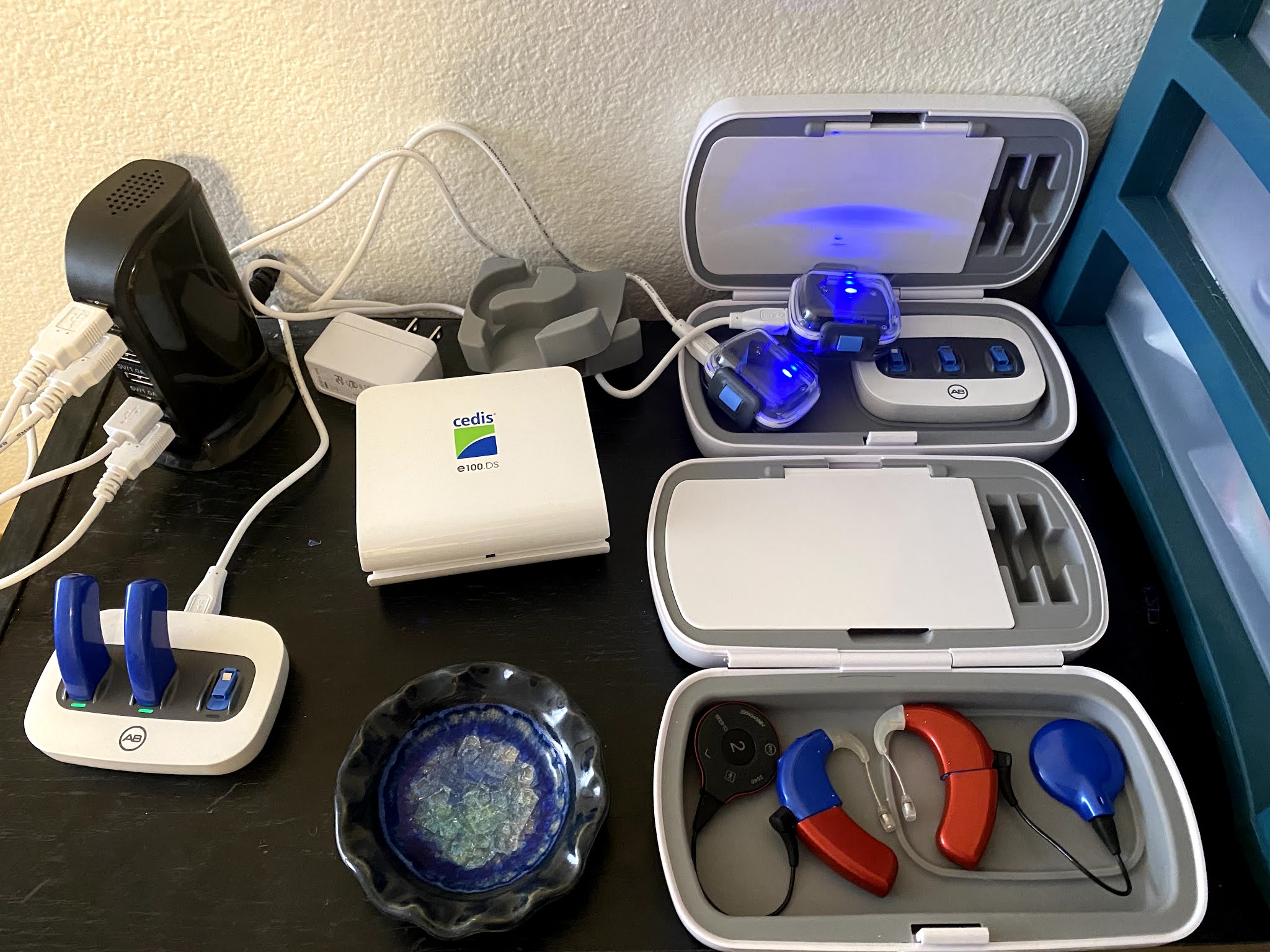
I ended up deciding I wanted to bring both processors for the trip, so I redid the packing of my implant processors. I packed the Harmony in the Harmony dry case and put that into the AB travel case. I stored 7 or 8 extra AAA in the Little Things wallet thingy, and that went in the travel case. The AquaMic and spare UHP was packed into the travel case. But somehow, I forgot to take the waterproof cover out of Neptune case, so that got left behind. Dang!

I had considered calling AB to see if they would overnight a cover cap for me. Ha ha.  I didn't.  I'll just have to take my nephew swimming when I get back home and give the Neptune a try then.  The quest for swimming with the Neptune has been delayed.

Wednesday, May 29, 2013

Getting ready for vacation

Next week I will be heading out for a short vacation to another state, which should be fun!  I have a cousin that is getting married, so that is where I am headed.  The hotel has a pool, which has me excited. Hopefully I'll have some free time so I can take the Neptune processor for a swim.  I have really been wanting to try the Neptune in a pool setting, but haven't had the opportunity to do so. So hopefully I'll get the chance next week.  I haven't gone swimming in such a long time.  I basically have quit swimming because I hated having to take my hearing aid off and not being able to hear what's going on.  Last time I swam, I think it was when I did the brief swim test in high school, and haven't been in a pool since then. That's a long time.  But now that I have the Neptune, I really ought to start going to the Aquatic Center or the Y and go for a swim.  My mom has been checking into taking swim lessons and I'd like to take them with her.  Having the Neptune would definitely be very useful and helpful during the lessons.

Am also debating on whether I should just take the Neptune, or both processors?  Seems to make more sense to just bring the Neptune, as I'll also be bringing my FM with me so I can listen to music during the trip, and that sort of thing.  Bringing both processors, I'd have to bring both cases, both sets of batteries, etc., I think I would just go crazy trying to keep track of everything!  Yeah, think I may just do the Neptune alone, and make sure to pack plenty of AAA batteries.


I also have a new earmold in the make as well.  Finally saw my hearing aid audie last week to get the earmold impression made.  I have requested a red cat-eye design for it, so we'll see how it turns out when Westone sends it back to the audie's office.  I probably won't get the earmold before I head out, which would be a bummer, but that's ok.  At least I'll have a new earmold at some point!

Monday, May 6, 2013

Got the CI tweaked!

Had my MAPping appointment today, and it went well!  Audie did the same test with my CI that she did when I was still in the OR, testing the nerve response.  She said each response looked beautiful and was very happy with it.  Then we got to making new MAPs.  P1 is the old program (60 IDR, HiRes-P), P2 is the new one (70 IDR, HiRes-P), and P3 is 70 IDR, HiRes-S.  This way I can experiment between HiRes P and S and see which one I like, and see how I tolerate the IDR 70.  So far I'm tolerating it, and have switched between P2 and P3 just for experiment's sake.  Tomorrow night's ASL Silent Dinner at On The Border should be a good place for me to experiment with the different programs, as well as the bowling alley this coming Saturday for deaf social and so on.  I didn't need more volume; been using the same volume level since October basically.  So now we can focus on trying different things, see which programming works best, that sort of thing.  She brought up all of the frequency levels a bit, and the very last one was brought up quite a bit as I was able to tolerate better today. 

My very good friend, who's been my interpreter for me in school from K-12, came as well.  She wanted to ask the audie a few questions, and I didn't mind her tagging along.  She was curious about the different programming strategies and that sort of thing too.

I can definitely say this.. P2 with HiRes-P, is loud.  P3 with HiRes-S is quieter, and audie brought up the volume levels for P3 too.  Thinking maybe she could have brought up the volume some more for P3, but that's ok.  That's what the volume dial is for.  Just have to remember to turn it down before switching back to P2!  Now let's make sure I'm not getting P1 and P3 mixed up on the Neptune... I always forget which slot is P1 and which is P3. P2 is obvious, as it's in the middle. But the other 2, I get them mixed up. Will have to look in the Neptune instructions book to make sure I have it right.


Also, last Friday was WYHI Day.  I went, and had a great time!  Usually WYHI is for deaf/hoh students in grades K-12, even preschoolers.  But plenty of adults still like to come too.  I really enjoyed myself, chatting with different people.  There was one person who came up to me and another interpreter (we were chatting, and she was asking if I knew who that person was and I said no), and I got t looking at him... Well, his face certainly is familiar, but his hair wasn't!  He was one of the coaches for the Wyoming team for the Deaf Academic Bowl in 2003 and 2004, and he was completely bald then.  I almost didn't recognize him with his hair.  But it was great chatting with him for a bit!  And my former school for the deaf teacher has told me to get to planning a reunion for our group from the deaf school days.  I've already been texting with one friend, asking if she'd help me plan it and recruit everyone.  I'm pretty excited with the reunion idea, and sure hope I hear back from everyone I've sent messages to.  So far I've only heard from one classmate.  Hopefully the others will chime in soon enough.  The friend that's helping, she'll contact her sister and brother, and another classmate, since they're all in Colorado, and will text yet another since I'm not sure how often he gets on facebook. It would be fun if we all could get together.

Saturday, April 27, 2013

New sounds, auditory rehab


There was a deaf ice cream social at the Dairy Queen today that I went to. It was fun, just hanging out, socializing a bit and just watching everyone socialize.

I picked up on a couple of new sounds. I heard the 1 year old girl smacking her lips as she ate her ice cream cone. I was a few chairs away from her and her mom, but I could hear her little lips smacking. And I only had the implant on, the hearing aid was off. I also teased a deaf friend a bit for being noisy.. He was just playing with the empty aluminum can he had. I kept hearing this sound, and it took me a few minutes of looking around until I realized it was just him crinkling the can.


Seems like I've been using the hearing aid much less than usual these days. Just focusing on listening with the implant and trying to make sense of what I'm hearing. I spent about half an hour using the Able rehab app on my iPad last night, just listening and doing my best to tap on the word I think is being said. As I get further along on the first level, it gets more trickier. Tike and dike, took and cook, key and tea.... the words that sound extremely similar are still tricky for me to get. But I'm still working at it. I also played around a bit with a piano app I have on the iPad, just to see if I could hear the difference between the keys right next to each other. I can't hear the difference between 2 keys right next to each other, but if I play 1 key, then aother that's further away from the first I can hear that difference. I think I can hear the slight difference with the implant though, but it's hard to tell.

I haven't done much with any auditory rehab tools lately. With school in the mornings, and work in the afternoons, by the time I get home I have dinner, do some homework, and then I'm just tired and want to take it easy. But I do try to watch TV with just the implant alone (unless a new episode is on, then I'm more likely to have the hearing aid on too).


Just got a statement from Medicare today, for the Prevnar 13 vaccine that I got in March.... $300?! Whew. Glad Medicare covered it.

Sunday, April 7, 2013

New Listening app from AB!

Advanced Bioncs now has a listening rehab app which can be downloaded for free from the App store iPads. Do search in the app store for 'Advanced Bionics' or 'able' and it should come up.  I've only tried 1 level so far, but so far I'm liking it.  It's similar to the Clix tool from AB's Listening Room.  Download the app and add it to your auditory rehab toolbox!

Updated 4-8-13: Here's the link for the able app from iTunes.


Thursday, March 28, 2013

Trying FM on Neptune again

After a few more attempts of trying to get the Phonak FM system to work with my Neptune with no results, and after a few emails back and forth with an AB regional specialist, he called AB and asked them to send me a new Neptune Connect, in hopes that would solve my FM problem.  Yesterday when I got home, there was a FedEx package waiting for me under my welcome mat.  Yay new Neptune Connect is here!  I dropped everything else I had with me onto my chair, then got the Neptune from the book case where I keep all my CI stuff on and got to work.  Took the original Connect off, put the new one on, plugged the MLxi FM receiver into the FM port on the Neptune connect, turned everything on and voila!  FM was working great.  Something must have gotten loose or something like that in the original Connect.  Hopefully I don't encounter this problem again.  I remember the first time I tried using the FM set up on my Neptune, months before I even got the new transmitter, and had no problems with getting the FM to work.  Worked great right off the bat but then a few months later (after getting the new Phonak transmitter), lots of trouble.  Hmmm...  The original Neptune Connect is being mailed back to AB today.

Was going to play with the FM today with my iPod... This morning, the iPod still had enough battery power that it should have lasted while I worked.  Tried turning the iPod on a few minutes ago, and nada.  Oh great.  It's charging now, but I can't play with it while it's charging, since it's an older iPod.  Wish my iPod Touch's audio port wasn't broken, it didn't matter if it was charging or not, it would still be playable.  Ah maybe I should just load some music to my iPhone instead... but alas, my desktop tower seems to be dead (and my iTunes is on that computer with all the music loaded on it).  I'll have to spend some time updating the iTunes on my laptop and resyncing the music over (good thing I have an external hard drive that has all of my music and photos!).  There's no school tomorrow, due to it being Good Friday, so perhaps I'll have some time to get my iTunes all set up on my laptop and get some music synced to the iPhone.

Technology.... most of the time it's fantastic, but there are moments when it's just a pain to deal with.

Wednesday, March 20, 2013

Georgia Tech team drastically improving cochlear implant device that assists thousands of hearing impaired

The cochlear implant is widely considered to be the most successful neural prosthetic on the market. The implant, which helps deaf individuals perceive sound, translates auditory information into electrical signals that go directly to the brain, bypassing cells that don't serve this function as they should because they are damaged.

According to the National Institute on Deafness and Other Communication Disorders, approximately 188,000 people worldwide have received cochlear implants since these devices were introduced in the early 1980s, including roughly 41,500 adults and 25,500 children in the United States.

Despite their prevalence, cochlear implants have a long way to go before their performance is comparable to that of the intact human ear. Led by Pamela Bhatti, an assistant professor in the School of Electrical and Computer Engineering, a team of researchers at the Georgia Institute of Technology has developed a new type of interface between the device and the brain that could dramatically improve the sound quality of the next generation of implants.

A normal ear processes sound the way a Rube Goldberg machine flips a light switch – via a perfectly-timed chain reaction involving a number of pieces and parts. First, sound travels down the canal of the outer ear, striking the eardrum and causing it to vibrate. The vibration of the eardrum causes small bones in the middle ear to vibrate, which in turn, creates movement in the fluid of the inner ear, or cochlea. This causes movement in tiny structures called hair cells, which translate the movement into electrical signals that travel to the brain via the auditory nerve.

Dysfunctional hair cells are the most common culprit in a type of hearing loss called sensorineural deafness, named for the resulting breakdown in communication between the ear and the brain. Sometimes the hair cells don't function properly from birth, but severe trauma or a bad infection can cause irreparable damage to these delicate structures as well.

Contemporary cochlear implants

Traditional hearing aids, which work by amplifying sound, rely on the presence of some functioning hair cells. A cochlear implant, on the other hand, bypasses the hair cells completely. Rather than restoring function, it works by translating sound vibrations captured by a microphone outside the ear into electrical signals. These signals are transmitted to the brain by the auditory nerve, which interprets them as sound.

Cochlear implants are only recommended for individuals with severe to profound sensorineural hearing loss, meaning those who aren't able to hear sounds below 70 decibels. (Conversational speech typically occurs between 20 and 60 decibels.)

The device itself consists of an external component that attaches via a magnetic disk to an internal component, implanted under the skin behind the ear. The external component detects sounds and selectively amplifies speech. The internal component converts this information into electrical impulses, which are sent to a bundle of thin wire electrodes threaded through the cochlea.

Improving the interface

As an electrical engineer, Bhatti sees the current electrode configuration as a significant barrier to clear sound transmission in the current device.

"In an intact ear, the hair cells are plentiful, and are in close contact with the nerves that transmit sound information to the brain," says Bhatti. "The challenge with the implant is getting efficient coupling between the electrodes and the nerves."

Contemporary implants contain between 12 and 22 wire electrodes, each of which conveys a signal for a different pitch. The idea is the more electrodes, the clearer the message.

So why not add more wire electrodes to the current design and call it a day?

Much like house-hunting in New York City, the problem comes down to a serious lack of available real estate. At its widest, the cochlea is 2 millimeters in diameter, or about the thickness of a nickel. As it coils, it tapers down to a mere 200 micrometers, about the width of a human hair.

"While we'd like to be able to increase the number of electrodes, the space issue is a major challenge from an engineering perspective," says Bhatti.

With funding from the National Science Foundation, Bhatti and her team have developed a new, thin-film, electrode array that is up to three times more sensitive than traditional wire electrodes, without adding bulk.

Unlike wire electrodes, the new array is also flexible, meaning it can get closer to the inner wall of the cochlea. The researchers believe this will create better coupling between the array and the nervous system, leading to a crisper signal.

According to Bhatti, one of the biggest challenges is actually implanting the device into the spiral-shaped cochlea.

"We could have created the best array in the world, but it wouldn't have mattered if the surgeon couldn't get it in the right spot," says Bhatti.

To combat this problem, the team has invented an insertion method that protects the array and serves as a guide for surgeons to ensure proper placement. The research is being done in collaboration with Georgia Regents University.

Before it's approved for use in humans, it will need to undergo rigorous testing to ensure that it is both safe and effective; however, Bhatti is already thinking about what's next. She envisions that one day, the electrodes won't need to be attached to an array at all. Instead, they will be anchored directly to the cochlea with a biocompatible material that will allow them to more seamlessly integrate with the brain.

The most important thing, according to Bhatti, is not to lose sight of the big picture.

"We are always designing with the end-user in mind," says Bhatti. "The human component is the most important one to consider when we translate science into practice."

Source: http://www.gatech.edu/newsroom/release.html?nid=200301